
Does an llms.txt file actually get your OpenCart store recommended by ChatGPT? Short answer: not directly, and anyone promising otherwise is skipping a real detail. Google has said on record that it doesn’t use the file for ranking, and most AI search crawlers still read HTML pages instead of fetching it.
That doesn’t make the file pointless. An OpenCart llms.txt file generator plugin still matters for a narrower, more concrete reason: giving AI agents and developer tools a clean, structured read of your catalog instead of forcing them to guess from raw HTML templates. An llms.txt generator for OpenCart stores exists specifically to produce that file correctly, without hand-editing it every time stock or pricing changes.
What an OpenCart llms.txt File Generator Plugin Actually Does
An OpenCart llms.txt file generator plugin produces a structured, Markdown-formatted summary of a store’s products, categories, and CMS pages, placed at the site root for AI systems to read. It works something like a robots.txt file, except instead of blocking crawlers, it hands them a curated map of what matters, written in plain text rather than templated HTML.
Structured product data matters here because AI crawlers work under tight time and token budgets. A machine-readable catalog file lets a bot read one organized document instead of parsing dozens of near-identical product pages to figure out what’s actually being sold.
That efficiency is the whole value proposition. It’s not a ranking trick. It’s a shortcut for machines that would otherwise have to reconstruct your catalog structure from scratch.
OpenCart AI Crawler Indexing: Which Bots Actually Read llms.txt
GPTBot, PerplexityBot, Google-Extended, DeepSeekBot, and Anthropic’s crawler are the AI crawler bots most commonly named in llms.txt discussions, and each one can, in principle, request the file. In practice, crawl-log research published through 2026 has repeatedly found that most of these bots still fetch HTML pages directly and rarely request /llms.txt at all.
Two audiences use it consistently, though. Developer-facing AI tools and MCP-based agent workflows read llms.txt reliably when building against a site’s data, which is agentic browsing in its most literal sense: a tool acting on a site rather than a person browsing it.
Google’s Chrome team backed that distinction in May 2026, when Lighthouse 13.3 shipped a new Agentic Browsing audit category that checks whether an llms.txt file exists at the domain root. It reports a pass ratio rather than a 0–100 score, and a missing file currently counts as a fail on that one check, not as a ranking penalty. That’s a genuinely different signal from Search visibility, and conflating the two is where most of the confusion about this file comes from.
What an OpenCart llms.txt File Does and Doesn’t Do
| Claim | Does it hold up in 2026? |
| Improves Google Search rankings | No, Google’s own optimization guide lists it as unnecessary |
| Guarantees a ChatGPT product recommendation | No, most AI search crawlers still read HTML pages instead |
| Helps AI agents and developer tools read your catalog cleanly | Yes, this is the confirmed, narrower use case |
| Replaces robots.txt or a sitemap | No, it’s a separate, complementary file with a different purpose |
| Passes the Lighthouse Agentic Browsing check | Yes, if the file exists and follows the basic Markdown spec |
OpenCart AI Product Discovery: What Actually Moves the Needle
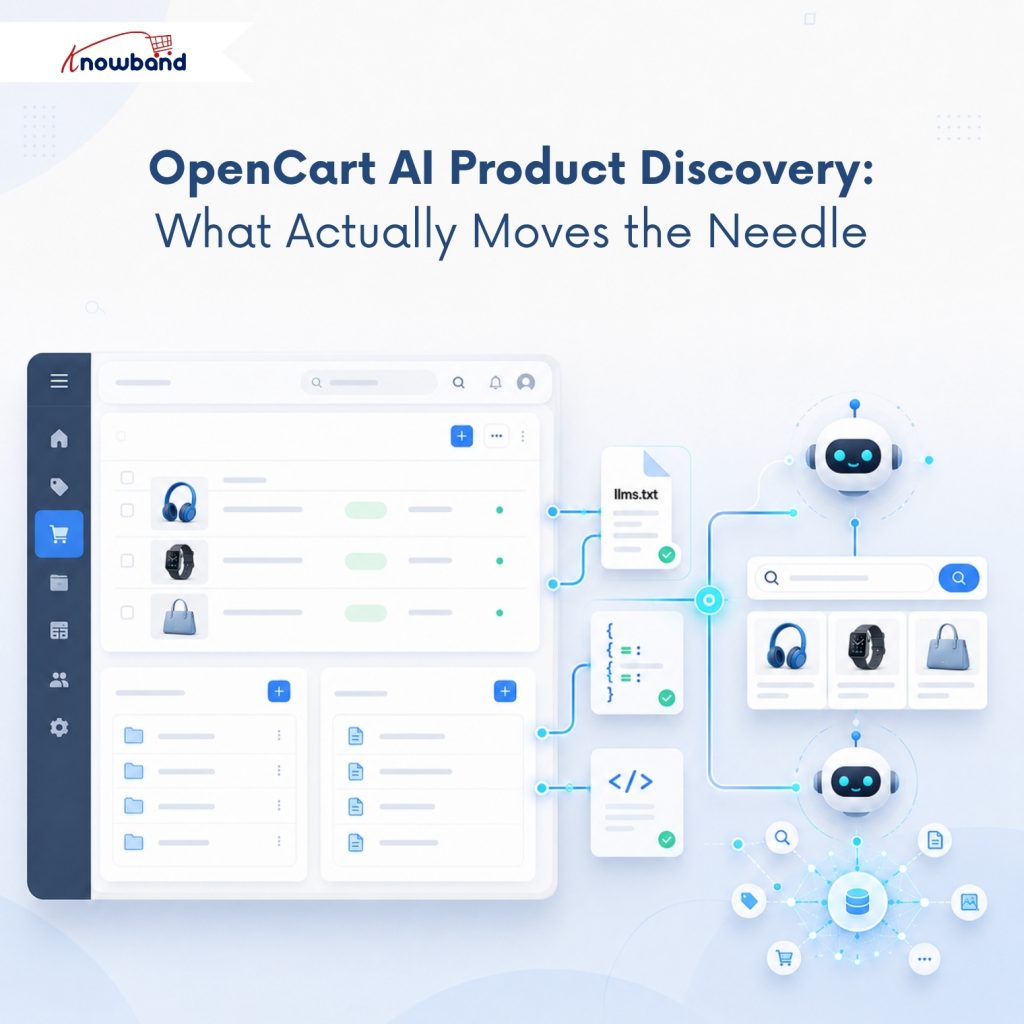
OpenCart AI product discovery still depends mostly on fundamentals unrelated to this one file: an accurate product schema, consistent naming across pages, and category or CMS content that directly answers the questions shoppers actually type. Generative engine optimization is the broader term for this work, and llms.txt sits inside it as a supporting file, not a substitute for it.
AI search visibility improves when a bot can confirm the same facts about a product in more than one place. The product page itself, structured schema markup, and, where relevant, a clean llms.txt entry, all reinforcing the same details rather than contradicting each other.
None of those three carries the job alone. A store with a well-built llms.txt file sitting on top of thin, inconsistent product pages hasn’t solved anything; the file just describes the problem more efficiently.
How the Knowband OpenCart LLMs TXT Generator Extension Handles This Correctly
The OpenCart LLMs TXT Generator Extension from Knowband builds this file directly from live catalog data instead of asking an admin to write and update it by hand. It pulls products, categories, and CMS pages into the correct Markdown structure through scheduled cron batches, so a catalog with thousands of SKUs doesn’t need a manual export every time stock or pricing changes.
Crawler access control lets an admin allow or block GPTBot, DeepSeekBot, PerplexityBot, Google-Extended, and Anthropic’s crawler individually, rather than exposing the file to every bot equally. Content filtering keeps the file limited to active, featured, or manually approved products and categories, so draft or discontinued items never surface in an AI’s answer.
That combination is what makes an OpenCart AI product discovery Extension worth running instead of a static file someone edits twice a year. Multi-store setups get their own dedicated file through the Shop Context setting, and customization fields let an admin add context around product, category, and CMS sections without touching the underlying catalog data.
Getting Your OpenCart llms.txt File Generator Plugin Set Up Correctly
An OpenCart llms.txt file generator plugin won’t move Google rankings, and it won’t guarantee a ChatGPT recommendation on its own. What it does is give AI agents, developer tools, and any AI answer engine that chooses to read it, a clean, current version of the catalog instead of a guess assembled from scraped HTML.
Store owners who want that groundwork handled through cron-based updates and crawler-level control, rather than a hand-edited text file, can look at an OpenCart AI crawler indexing Extension built for exactly this. The Knowband extension handles the batching, filtering, and access control so the file stays accurate as the catalog changes, which matters more than the file’s mere existence ever will.
For more such reads, you can visit:

