
Running an OpenCart store takes real work. You’ve spent time getting the catalogue right, sorting out shipping, and figuring out what sells and what doesn’t. And after all that, your products are still only visible to people who happen to find your store. That’s a problem because the internet is enormous and most shoppers never go looking for individual stores directly. They go to eBay, search on Google, or browse Etsy on a Sunday afternoon. If you’re not on those platforms, you’re simply not in the room.
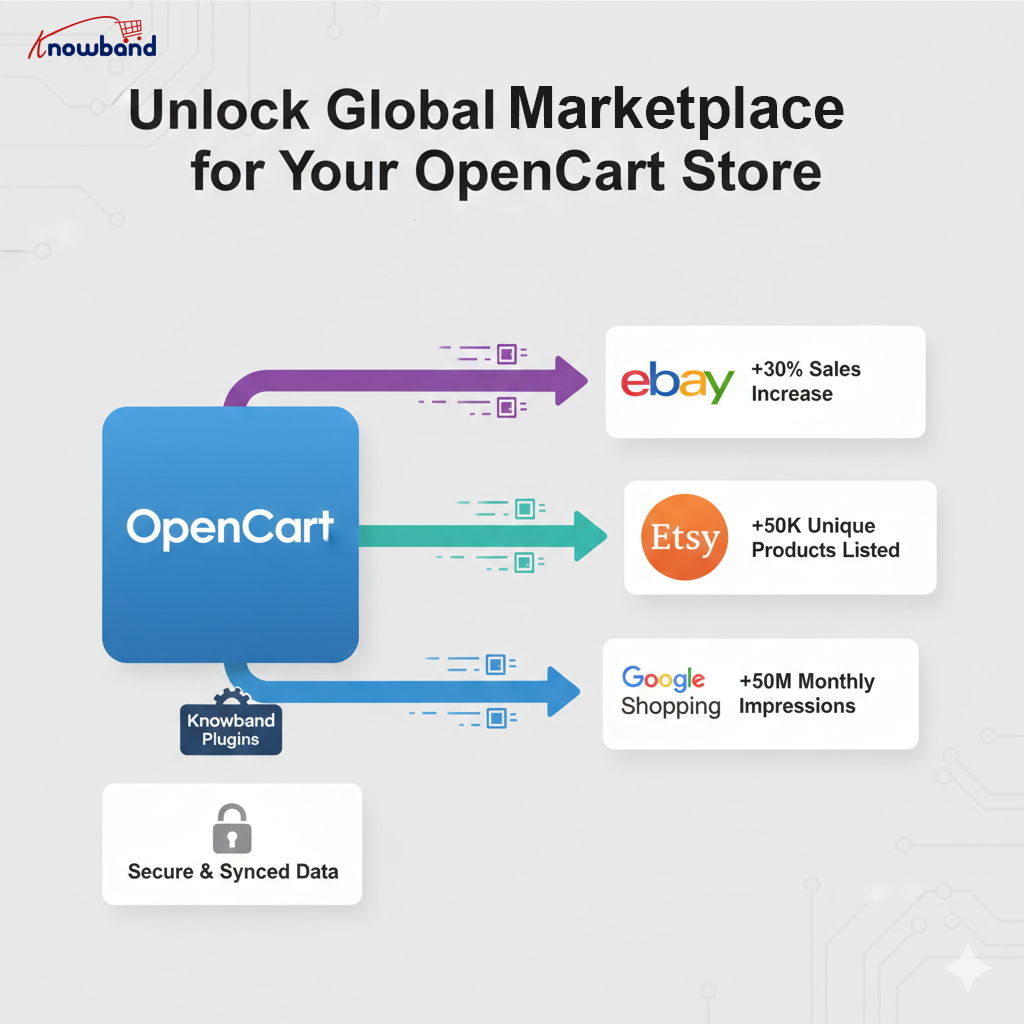
Managing three extra platforms might sound exhausting. Separate logins, manual uploads, and trying to keep inventory numbers consistent across multiple places. Nobody has time for that. What changes the equation is having integrations that work, pulling from your existing OpenCart data and pushing it to each channel without constant oversight. That’s what Knowband’s OpenCart Marketplace Plugins are built to do.
eBay Marketplace
eBay has hundreds of millions of registered buyers and a search volume most standalone stores could only dream of. It’s strong in electronics, auto parts, tools, fashion, collectables, and home goods, but a wide range of products sell well there. Buyers on eBay compare multiple listings, checking prices and seller ratings. If your listing is solid and pricing is fair, you can achieve consistent sales.
The Knowband OpenCart eBay Integration Plugin connects your OpenCart store to your eBay seller account. Listings go out from your catalog, stock levels stay in sync, and orders from eBay show up in your OpenCart backend. Mapping your existing product data makes the process faster and less error-prone. Day-to-day management becomes much lighter.
Etsy Marketplace
Etsy shoppers aren’t hunting for the lowest price, they want something unique, handmade, vintage, or personalised. If part of your catalog fits that description, Etsy is worth reaching. The Knowband OpenCart Etsy Integration Extension handles listings, inventory updates, and orders through your OpenCart dashboard, without building a separate Etsy shop.
Etsy shoppers who like your products might visit your OpenCart store directly for future purchases, bypassing marketplace fees and building your own customer relationships.
Google Shopping
Google Shopping puts your products directly into search results when someone is actively looking to buy. The Knowband OpenCart Google Shopping Integration Extension connects your catalogue to Google Merchant Centre and manages your product feed automatically. Stock changes, price updates, and new products sync without manual exporting.
The Google Shopping Integration for Opencart supports UTM tracking, so analytics show which campaigns and products are converting. Furthermore, it also works with Performance Max campaigns, extending your reach across Search, Display, YouTube, and Gmail.
Covering Different Buyer Segments
eBay, Etsy, and Google Shopping attract different shoppers. Etsy buyers seeking unique gifts are not the same as buyers actively searching on Google, and neither are the same as price-comparing eBay shoppers. Using Knowband’s OpenCart Marketplace Plugins allows you to cover all three segments from one catalogue without fragmenting operations. Inventory stays consistent, orders come into one system, and product data is managed once.
More Channels, More Revenue
Each marketplace adds potential customers who would not have found your store otherwise. Being present on all three increases visibility and builds trust. Furthermore, customers encountering your brand on multiple platforms perceive it as established and legitimate, which helps credibility.
Conclusion
Relying on a single channel is not that productive. eBay, Etsy, and Google Shopping each bring different buyers, intents, and discovery moments. Knowband’s OpenCart Marketplace Plugins like eBay, Etsy, and Google Shopping Extension, make it practical to be present on all three without tripling your workload. For OpenCart store owners ready to stop leaving revenue on the table, this is a sensible and efficient place to start.


