
A customer purchases your last handmade ceramic mug on Etsy on a Tuesday night, but your OpenCart store still shows three mugs in stock. By Wednesday morning, another customer places an order through your website, leaving you with an oversold order, a refund to process, and an unhappy customer.
For many multichannel sellers, keeping inventory accurate across different marketplaces can be challenging. An OpenCart Etsy Connector helps solve this issue by automatically synchronizing product inventory between OpenCart and Etsy. A connector built for syncing OpenCart with Etsy keeps stock levels consistent across both platforms, helping prevent overselling, reduce order cancellations, and provide a better customer experience.
Why Manual Etsy and OpenCart Inventory Tracking Breaks Down
Etsy’s active buyer base has grown substantially over the past several years, and handmade or vintage sellers keep adding the marketplace as a second channel for exactly that reason. The catch is that Etsy and OpenCart don’t talk to each other by default, which means every sale on one platform has to be reflected on the other manually.
That manual step sounds manageable until order volume picks up. One inventory audit found a shop’s rating drop from 4.9 to 4.6 stars within two months, traced entirely to stock mismatches between two unsynced platforms. Etsy buyers filter by rating before they even open a listing, so that kind of drop closes doors fast.
Spreadsheets don’t fix this either. A spreadsheet only reflects reality at the moment someone last updated it, and updating it after every sale on two platforms is its own full-time habit that most sellers eventually abandon.
What Changes With an OpenCart Etsy Connector in Place
| Task | Manual Process | With a Connector |
| Stock updates | Manually matched after each sale | Synced both directions automatically |
| Order import | Checked and re-entered by hand | Pulled into OpenCart via scheduled cron |
| Category mapping | Redone per listing | Set once per profile, reused |
| Shipping rules | Rebuilt on each platform | Created in OpenCart, synced to Etsy |
| Order status updates | Updated separately on both sites | Pushed automatically from OpenCart |
The table above captures what actually changes day to day. The bigger shift is less visible: sellers stop reacting to mismatches and start trusting that both platforms show the same number, which is what makes multichannel selling sustainable instead of a constant fire drill.
How the Sync Actually Works Behind the Scenes
An OpenCart Etsy Synchronization Extension doesn’t just push a one-time product export. It runs scheduled cron jobs that check for changes in both directions: a stock update in OpenCart flows out to Etsy, and an order placed on Etsy flows back into OpenCart’s order list, typically on an hourly cycle for products and orders.
Category and attribute mapping happens once, inside a profile, rather than being rebuilt every time a product gets listed. A seller maps an OpenCart category to the matching Etsy category, and every product added to that category afterward inherits the mapping automatically.
Shipping templates work the same way. Build the shipping rule once in the OpenCart admin, and it syncs to Etsy through the same scheduled process, so pricing and delivery windows stay consistent without touching Etsy’s own seller dashboard for routine changes.
Choosing an Etsy OpenCart Integration Extension for Real Order Volume
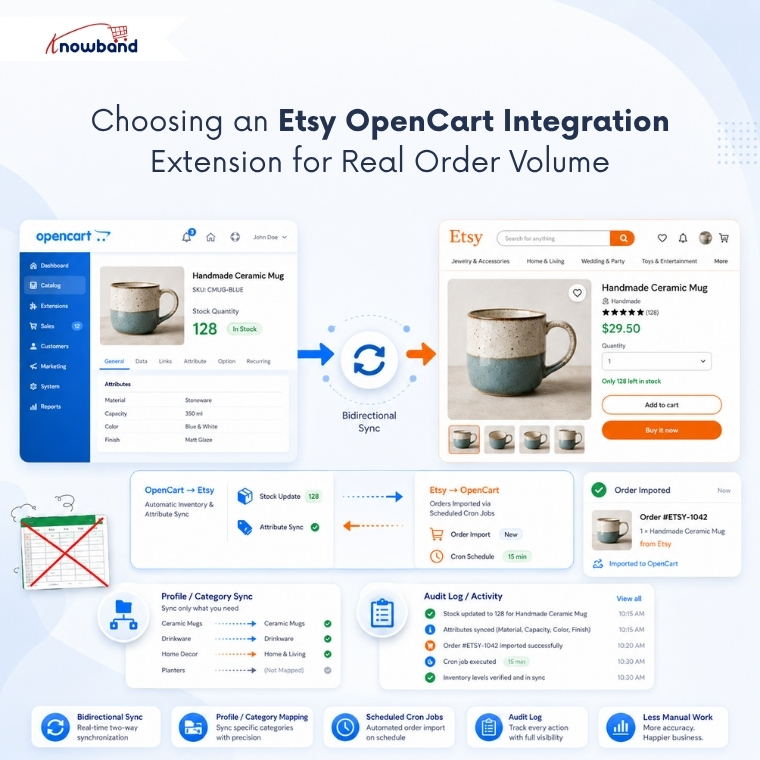
Not every connector on the market handles bidirectional sync the same way. Some tools only push products outward and leave order import as a manual step, which defeats a good chunk of the purpose for a seller trying to get out from under spreadsheet tracking.
The Knowband OpenCart Etsy Marketplace Integration is built around full bidirectional sync rather than one-way listing. A few specifics matter here for anyone comparing options:
- Inventory and attribute changes made in OpenCart push to Etsy automatically, which is the exact gap that caused the 4.9-to-4.6 rating drop mentioned earlier.
- Orders placed on Etsy import into the OpenCart admin through a scheduled cron, so nothing needs re-entering by hand.
- Profile-level product synchronization lets a seller list specific categories rather than the entire catalog in one bulk push, which keeps listings targeted instead of dumping every SKU onto Etsy at once.
- An audit log records every sync action, so when something looks off, there’s a record of exactly what happened and when, rather than a guessing game.
This is the kind of Etsy OpenCart Integration Extension that treats order management and stock accuracy as the actual product, not a side feature bolted onto a listing tool.
Getting Started Without Breaking Your Existing Listings
Setup starts on Etsy’s side, not OpenCart’s. A seller needs an active Etsy seller account and a registered app on Etsy’s developer portal to generate the API key and secret that the connector authenticates with; this step occurs on Etsy’s end regardless of which integration tool is used.
Once that key is in place, the practical sequence is: connect the API credentials in the OpenCart admin, build a shipping template or two, set up one profile mapping a single category, and run a first sync on a small batch of products before listing the full catalog. Testing on ten or twenty products first catches mapping errors while the stakes are still low.
Return policy synchronization is worth setting up early too, since Etsy applies return rules per listing and mismatched policies between platforms create the same kind of customer confusion that mismatched stock does. Map it once per profile, and every category under that profile automatically inherits the same return terms.
Making Etsy a Channel, Not a Second Job
Running OpenCart and Etsy side by side doesn’t have to mean living in two admin panels or trusting a spreadsheet that’s already a day out of date. An OpenCart Etsy Connector turns that ongoing manual reconciliation into a background process that runs on its own schedule.
For sellers weighing whether Etsy is worth adding as a channel, the honest answer is that the marketplace itself isn’t the hard part; inventory accuracy across two platforms is. Getting that piece right with a proper OpenCart Etsy Synchronization Extension is what determines whether Etsy becomes a genuine second revenue stream or a source of oversold orders and refund requests.


