
Getting a customer to add something to their cart is only half the job; the checkout process is where most stores actually lose them. Research consistently shows that complicated, drawn-out checkout flows are among the leading causes of abandoned orders, and OpenCart’s default multi-step process does not help. How many sales is your store losing between the cart and the confirmation page? OpenCart One Page Checkout by Knowband answers that question by removing the steps, page transitions, and repeated form submissions that push buyers out before they finish.
What Is OpenCart One Page Checkout?
OpenCart One Page Checkout is a module that collapses the entire checkout process into a single page. Instead of moving through separate screens for address entry, shipping selection, and payment, customers handle all of it at once without a single page reload. Store owners use it to shorten the time between cart and confirmed order, reduce abandonment at the checkout stage, and give buyers a purchase experience that does not get in its own way.
Why Checkout Barriers Cost OpenCart Stores Real Revenue
Multi-page checkouts create friction at every transition. A customer who has to submit their billing details and wait for the next page to load before entering a shipping address is being asked to stay patient through a process that feels unnecessarily slow, and many simply do not.
Form length plays a role, too. When fields are spread across multiple steps, the checkout feels longer than it actually is because customers cannot see the full picture at once. Each new page feels like another commitment rather than progress toward the finish line.
The OpenCart fast checkout extension solves both problems. The full set of fields, address, delivery, and payment, is visible from the start. Customers can move through the form at their own pace, and the order goes through without any page transitions slowing things down.
OpenCart One Page Checkout vs Default OpenCart Checkout Flow
OpenCart’s standard checkout breaks the purchase into steps that each require their own page load and form submission before the next one becomes available. Here is how that compares directly:
| Factor | Default OpenCart Checkout | OpenCart One Page Checkout |
| Checkout Speed | Requires multiple page loads | Completes on a single page |
| User Friction | High, each step interrupts the flow | Low, full form visible from the start |
| Mobile Experience | Slow and difficult on small screens | Responsive and built for touch |
| Form Complexity | Separate submission required per step | One form, one submission |
| Conversion Rate Impact | Drop-off risk at every step transition | Fewer exits, faster order completions |
Stores running the default checkout are asking customers to do more work than necessary for order completion. OpenCart One Page Checkout cuts that process down to what it actually needs to be, and for any store tracking checkout drop-off, the improvement tends to be visible quickly.
Features of OpenCart One Page Checkout
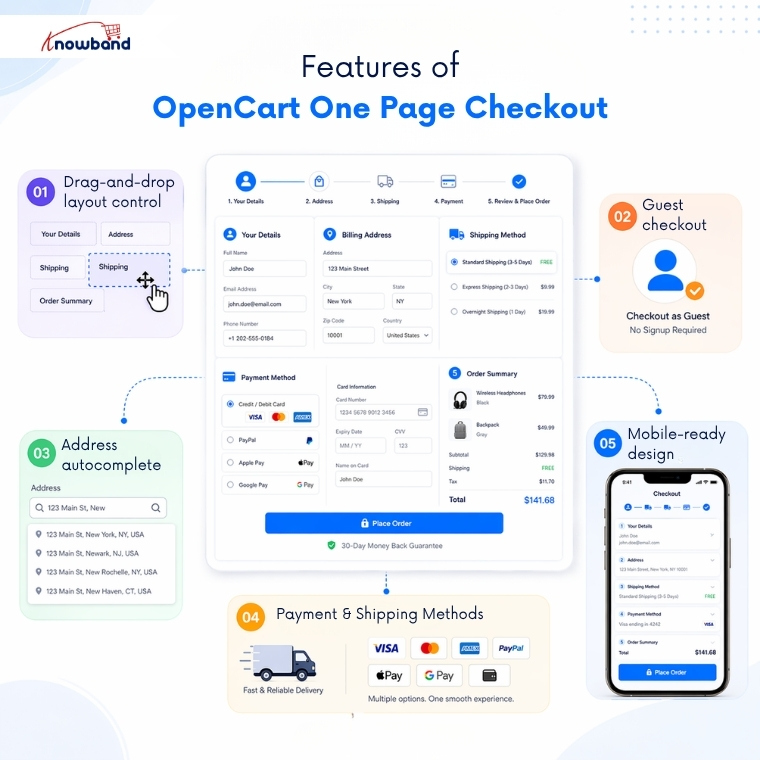
Consolidated Single-Page Form with Drag-and-Drop Layout Control
When checkout is spread across multiple pages, customers commit to each section blindly without knowing what comes next. The module puts the entire form on one screen, organized into a 1, 2, or 3-column layout that the admin selects and arranges from the backend. Fields can be repositioned using drag and drop without touching any code.
This gives store owners direct control over how the checkout page looks and flows. A well-structured single-page form feels faster to complete because customers can see everything at once and work through it without waiting between steps.
Guest Checkout with Optional Silent Registration
Requiring account creation before a first purchase is a barrier most new visitors are not willing to clear. Many will leave rather than sign up for an account they did not plan on creating. The module lets customers complete their order as a guest with no registration required before checkout.
Stores that want to keep those customers in their database can turn on automatic registration in the backend settings. The account gets created after the order goes through, with no extra steps presented to the buyer during checkout.
Google Address Autocomplete with Real-Time Field Validation
Address entry is one of the slowest and most error-prone parts of any checkout, particularly on mobile, where typing is less precise. Delivery problems that stem from incorrect addresses waste time for both the store and the customer. The module connects with Google address autocomplete, so the shipping field fills in quickly as the customer starts typing, reducing manual input and the chance of errors.
Field validation works in real time as the customer moves through the form. Any missing or incorrectly filled fields get flagged on the spot rather than after the customer tries to submit, which keeps the process moving and reduces the back-and-forth that comes with submission errors.
Payment and Shipping Method Support with Ship2Pay
Customers check the payment section to confirm their preferred method is available; if it is not, many will not proceed. The module supports all major payment and shipping methods within the single-page layout, displayed clearly so there are no surprises before the customer places the order.
Ship2Pay lets admins control which payment methods appear based on the shipping option a customer has selected. Only the relevant payment choices show up, keeping the page clean and making the final step of checkout straightforward rather than cluttered with options that do not apply.
Mobile-Ready Checkout Built for How People Actually Shop
A growing share of purchases happens on phones, but most checkout drop-off also happens on phones, largely because multi-step flows are harder to complete on a small screen. The OpenCart Single Page checkout module is built to work properly on mobile, with a layout that adjusts to screen size, buttons sized for touch, and fields that stay easy to interact with without zooming.
Social login support through Google, Facebook, and PayPal gives returning customers on mobile a faster way to authenticate. Typing credentials on a phone keyboard is something a lot of people avoid, and giving them a one-tap alternative keeps more of them moving through to the order confirmation.
Conclusion
Checkout drop-off is almost always a design problem, too many steps, too many page loads, too much asked of the customer at the worst possible moment. OpenCart One Page Checkout removes those barriers and replaces them with a single, well-structured page that gets buyers from cart to confirmed order as quickly as possible. Knowband designed this module for OpenCart stores that treat checkout conversion as a priority, not an afterthought. If lost sales at checkout are a recurring problem, the OpenCart fast checkout extension is where the fix starts.
For more such posts, you can visit:


